

What Kind Of Paint Is Easy To Clean


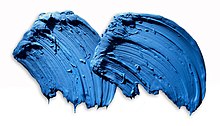
Paint is whatever pigmented liquid, liquefiable, or solid mastic composition that, after awarding to a substrate in a thin layer, converts to a solid motion picture. It is most normally used to protect, colour, or provide texture to objects. Paint can be made or purchased in many colors—and in many different types, such as watercolor or constructed. Paint is typically stored, sold, and applied as a liquid, but almost types dry into a solid. Well-nigh paints are either oil-based or water-based and each has distinct characteristics. For one, it is illegal in most municipalities to discard oil-based pigment downwardly household drains or sewers. Make clean-up solvents are too different for water-based paint than they are for oil-based paint.[one] Water-based paints and oil-based paints will cure differently based on the outside ambient temperature of the object being painted (such as a house.) Usually, the object being painted must be over 10 °C (50 °F), although some manufacturers of external paints/primers claim they can exist applied when temperatures are as depression as 2 °C (35 °F).[two]
History [edit]
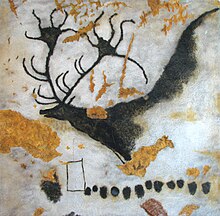
Paint was one of the primeval arts of humanity. Some cave paintings drawn with red or yellow ochre, hematite, manganese oxide, and charcoal may have been made by early on Homo sapiens as long as xl,000 years ago.[3] Pigment may be even older. In 2003 and 2004, Southward African archeologists reported finds in Blombos Cave of a 100,000-year-old human-made ochre-based mixture that could have been used like paint.[4] [v] Further excavation in the same cave resulted in the 2011 report of a complete toolkit for grinding pigments and making a primitive pigment-like substance.[5] [six]
Interior walls at the 5,000-year-old Ness of Brodgar have been found to incorporate individual stones painted in yellows, reds, and oranges, using ochre pigment fabricated of haematite mixed with animal fatty, milk or eggs.[7] [8]
Ancient colored walls at Dendera, Egypt, which were exposed for years to the elements, still possess their brilliant colour, equally vivid equally when they were painted about ii,000 years agone. The Egyptians mixed their colors with a gummy substance and applied them separately from each other without any blending or mixture. They appear to have used six colors: white, black, bluish, red, yellow, and green. They get-go covered the area entirely with white, then traced the design in black, leaving out the lights of the ground color. They used minium for carmine, more often than not of a nighttime tinge.
The oldest known oil paintings are Buddhist murals created circa 650 Ad. The works are located in cavern-similar rooms carved from the cliffs of Afghanistan's Bamiyan Valley, "using walnut and poppy seed oils."[9] Pliny mentions some painted ceilings in his day in the boondocks of Ardea, which had been fabricated prior to the foundation of Rome. He expressed great surprise and admiration at their freshness, after the lapse of so many centuries.
In the 13th century, oil was used to item tempera paintings. In the 14th century, Cennino Cennini described a painting technique utilizing tempera painting covered by light layers of oil. The slow-drying properties of organic oils were normally known to early European painters. However, the difficulty in acquiring and working the materials meant that they were rarely used (and indeed the tiresome drying was seen every bit a disadvantage[x]). Paint was made with the yolk of eggs and therefore, the substance would harden and attach to the surface it was practical to. Paint was fabricated from plants, sand, and different soils. Most paints used either oil or water every bit a base (the diluent, solvent or vehicle for the pigment).
The Flemish-trained or influenced Antonello da Messina, who Vasari wrongly credited with the introduction of oil paint to Italy,[eleven] does seem to accept improved the formula by adding litharge, or lead (Two) oxide. A still extant example of 17th-century house oil painting is Ham House in Surrey, England, where a primer was used forth with several undercoats and an elaborate decorative overcoat; the pigment and oil mixture would take been ground into a paste with a mortar and pestle. The process was done past paw by the painters, which exposed them to lead poisoning, due to the white-lead powder.
In 1718, Marshall Smith invented a "Machine or Engine for the Grinding of Colours" in England. It is not known precisely how it operated, simply information technology was a device that increased the efficiency of pigment grinding dramatically. Presently, a company chosen Emerton and Manby was ad exceptionally depression-priced paints that had been footing with labor-saving technology:
Paint used in every solar day - white paint on a wall
- One Pound of Color ground in a Horse-Mill will paint twelve Yards of Work, whereas Color ground whatever other Way, will not do half that Quantity.
By the proper onset of the Industrial Revolution, in the mid-18th century, paint was existence ground in steam-powered mills, and an alternative to pb-based pigments had been found in a white derivative of zinc oxide. Interior firm painting increasingly became the norm as the 19th century progressed, both for decorative reasons and because the paint was effective in preventing the walls rotting from damp. Linseed oil was also increasingly used as an cheap binder.
In 1866, Sherwin-Williams in the United States opened every bit a large pigment-maker and invented a paint that could be used from the tin can without grooming.
It was not until the stimulus of Earth War II created a shortage of linseed oil in the supply marketplace that bogus resins, or alkyds, were invented. Cheap and easy to make, they also held the colour well and lasted for a long time.[12]
Components [edit]
Vehicle [edit]
The vehicle is composed of the binder; or, if information technology is necessary to sparse the folder with a diluent similar solvent or water, it is the combination of binder and diluent.[thirteen] [14] In this instance, once the paint has dried or cured very well-nigh all of the diluent has evaporated and merely the binder is left on the coated surface. Thus, an important quantity in coatings formulation is the "vehicle solids", sometimes chosen the "resin solids" of the formula. This is the proportion of the wet coating weight that is binder, i.e. the polymer backbone of the film that will remain afterward drying or curing is consummate.
Binder or film former [edit]
The folder is the movie-forming component of paint.[fifteen] It is the but component that is e'er present among all the various types of formulations. Many binders are too thick to exist applied and must exist thinned. The type of thinner, if present, varies with the folder.
The binder imparts properties such as gloss, durability, flexibility, and toughness.[16]
Binders include synthetic or natural resins such equally alkyds, acrylics, vinyl-acrylics, vinyl acetate/ethylene (VAE), polyurethanes, polyesters, melamine resins, epoxy, silanes or siloxanes or oils.
Binders tin can be categorized co-ordinate to the mechanisms for film formation. Thermoplastic mechanisms include drying and coalescence. Drying refers to simple evaporation of the solvent or thinner to get out a coherent film behind. Coalescence refers to a mechanism that involves drying followed by actual interpenetration and fusion of formerly discrete particles. Thermoplastic film-forming mechanisms are sometimes described as "thermoplastic cure" but that is a misnomer because no chemical curing reactions are required to knit the pic. Thermosetting mechanisms, on the other hand, are truthful curing machinery that involve chemical reaction(s) amongst the polymers that brand up the folder.[17]
Thermoplastic mechanisms: Some films are formed past uncomplicated cooling of the folder. For instance, encaustic or wax paints are liquid when warm, and harden upon cooling. In many cases, they re-soften or liquify if reheated.
Paints that dry by solvent evaporation and incorporate the solid binder dissolved in a solvent are known every bit lacquers. A solid motion picture forms when the solvent evaporates. Because no chemical crosslinking is involved, the film can re-dissolve in solvent; every bit such, lacquers are unsuitable for applications where chemical resistance is important. Classic nitrocellulose lacquers fall into this category, equally do non-grain raising stains equanimous of dyes dissolved in solvent. Performance varies by formulation, but lacquers generally tend to have ameliorate UV resistance and lower corrosion resistance than comparable systems that cure by polymerization or coalescence.
The paint type known as Emulsion in the United kingdom and Latex in the United states is a h2o-borne dispersion of sub-micrometer polymer particles. These terms in their respective countries cover all paints that utilize synthetic polymers such as acrylic, vinyl acrylic (PVA), styrene acrylic, etc. as binders.[eighteen] The term "latex" in the context of pigment in the United States simply ways an aqueous dispersion; latex rubber from the prophylactic tree is not an ingredient. These dispersions are prepared by emulsion polymerization. Such paints cure by a procedure called coalescence where first the water, and and then the trace, or coalescing, solvent, evaporate and draw together and soften the binder particles and fuse them together into irreversibly bound networked structures, then that the paint cannot redissolve in the solvent/water that originally carried it. The residuum surfactants in paint, likewise as hydrolytic effects with some polymers cause the paint to remain susceptible to softening and, over time, degradation by water. The general term of latex pigment is usually used in the Us, while the term emulsion paint is used for the same products in the UK and the term latex pigment is not used at all.
Thermosetting mechanisms: Paints that cure by polymerization are generally i- or two-packet coatings that polymerize by fashion of a chemical reaction, and cure into a cross-linked movie. Depending on limerick they may need to dry first, by evaporation of solvent. Archetype two-package epoxies or polyurethanes [xix] would autumn into this category.[20]
The "drying oils", counter-intuitively, actually cure by a crosslinking reaction even if they are not put through an oven wheel and seem to simply dry in air. The film formation machinery of the simplest examples involve first evaporation of solvents followed by reaction with oxygen from the environment over a period of days, weeks and even months to create a crosslinked network.[13] Classic alkyd enamels would fall into this category. Oxidative cure coatings are catalyzed by metallic circuitous driers such as cobalt naphthenate though cobalt octoate is more common.
Recent ecology requirements restrict the utilise of volatile organic compounds (VOCs), and alternative means of curing have been developed, generally for industrial purposes. UV curing paints, for example, enable formulation with very low amounts of solvent, or even none at all. This tin can be achieved because of the monomers and oligomers used in the coating have relatively very low molecular weight, and are therefore depression plenty in viscosity to enable proficient fluid flow without the demand for additional thinner. If solvent is present in significant amounts, mostly it is mostly evaporated kickoff and then crosslinking is initiated past ultraviolet calorie-free. Similarly, powder coatings contain piffling or no solvent. Flow and cure are produced by the heating of the substrate after electrostatic awarding of the dry out powder.[21]
Combination mechanisms: So-called "catalyzed" lacquers" or "crosslinking latex" coatings are designed to form films by a combination of methods: classic drying plus a curing reaction that benefits from the catalyst. There are paints called plastisols/organosols, which are made past blending PVC granules with a plasticiser. These are stoved and the mix coalesces.
Diluent or solvent or thinner [edit]
The primary purposes of the diluent are to deliquesce the polymer and adjust the viscosity of the paint. It is volatile and does not become part of the paint film. It also controls flow and application backdrop, and in some cases can affect the stability of the paint while in liquid state. Its main part is equally the carrier for the non-volatile components. To spread heavier oils (for example, linseed) as in oil-based interior business firm paint, a thinner oil is required. These volatile substances impart their properties temporarily—once the solvent has evaporated, the remaining pigment is fixed to the surface.
This component is optional: some paints accept no diluent.
Water is the primary diluent for h2o-borne paints, even the co-solvent types.
Solvent-borne, too called oil-based, paints can accept various combinations of organic solvents as the diluent, including aliphatics, aromatics, alcohols, ketones and white spirit. Specific examples are organic solvents such as petroleum distillate, esters, glycol ethers, and the similar. Sometimes volatile low-molecular weight constructed resins as well serve as diluents.
Paint, dye and filler [edit]
Pigments are granular solids incorporated in the paint to contribute color. Dyes are colorants that deliquesce in the pigment. Fillers are granular solids incorporated to impart toughness, texture, give the pigment special properties,[22] or to reduce the cost of the paint. During production, the size of such particles can be measured with a Hegman gauge. Rather than using but solid particles, some paints contain dyes instead of or in combination with pigments.
Pigments tin be classified equally either natural or constructed. Natural pigments include diverse clays, calcium carbonate, mica, silicas, and talcs. Synthetics would include engineered molecules, calcined clays, blanc fixe, precipitated calcium carbonate, and synthetic pyrogenic silicas.
Hiding pigments, in making paint opaque, as well protect the substrate from the harmful effects of ultraviolet light. Hiding pigments include titanium dioxide, phthalo bluish, carmine iron oxide, and many others.
Fillers are a special type of paint that serve to thicken the pic, support its structure and increase the volume of the paint. Fillers are usually inexpensive and inert materials, such every bit diatomaceous earth, talc, lime, barytes, clay, etc. Flooring paints that must resist abrasion may contain fine quartz sand equally a filler. Not all paints include fillers. On the other hand, some paints comprise large proportions of paint/filler and binder.
Some pigments are toxic, such every bit the lead pigments that are used in lead paint. Pigment manufacturers began replacing white lead pigments with titanium white (titanium dioxide), earlier atomic number 82 was banned in paint for residential use in 1978 by the US Consumer Product Safety Commission. The titanium dioxide used in near paints today is oft coated with silica/alumina/zirconium for various reasons, such as better outside durability, or better hiding performance (opacity) promoted past more optimal spacing inside the paint film.[23]
Micaceous iron oxide (MIO) is some other alternative to lead for protection of steel, giving more than protection against water and light damage than most paints. When MIO pigments are basis into fine particles, well-nigh carve into shiny layers, which reflect light, thus minimising UV degradation and protecting the resin folder. Most pigments used in paint tend to be spherical, but lamellar pigments, such every bit glass flake and MIO have overlapping plates, which impede the path of water molecules.[24] For optimum performance MIO should accept a loftier content of sparse fleck-like particles resembling mica. ISO 10601 sets two levels of MIO content.[25] MIO is oftentimes derived from a form of hematite.
Additives [edit]
Too the iii main categories of ingredients, paint can accept a wide variety of miscellaneous additives, which are commonly added in pocket-size amounts, yet provide a significant effect on the production. Some examples include additives to change surface tension, improve catamenia backdrop, improve the finished appearance, increase moisture edge, meliorate pigment stability, impart antifreeze properties, control foaming, command skinning, etc. Other types of additives include catalysts, thickeners, stabilizers, emulsifiers, texturizers, adhesion promoters, UV stabilizers, flatteners (de-glossing agents), biocides to fight bacterial growth and the similar.
Additives normally practise not significantly change the percentages of individual components in a conception.[26]
Colour irresolute [edit]
Various technologies exist for making paints that change color. Thermochromic ink and coatings contain materials that change conformation when estrus is applied or removed, and and then they alter colour. Liquid crystals have been used in such paints, such as in the thermometer strips and tapes used in aquaria and novelty/promotional thermal cups and straws.
Photochromic materials are used to brand eyeglasses and other products. Similar to thermochromic molecules, photochromic molecules modify conformation when lite free energy is applied or removed, and and then they change color.
Color-irresolute paints can too be made by calculation halochromic compounds or other organic pigments. One patent[27] cites apply of these indicators for wall coating applications for light-colored paints. When the pigment is wet it is pink in color only upon drying it regains its original white color. Equally cited in patent, this holding of the pigment enabled two or more coats to be applied on a wall properly and evenly. The previous coats having dried would be white whereas the new wet coat would exist distinctly pink. Ashland Inc. introduced foundry refractory coatings with similar principle in 2005[28] [29] for apply in foundries.
Electrochromic paints change color in response to an applied electric current. Machine manufacturer Nissan has been reportedly working on an electrochromic paint, based on particles of paramagnetic iron oxide. When subjected to an electromagnetic field the paramagnetic particles change spacing, modifying their color and reflective properties. The electromagnetic field would be formed using the conductive metal of the car body.[30] Electrochromic paints can exist applied to plastic substrates too, using a dissimilar coating chemistry. The technology involves using special dyes that modify conformation when an electrical current is applied across the film itself. This new engineering science has been used to achieve glare protection at the touch of a button in passenger aeroplane windows.
Color can also change depending on viewing bending, using iridescence, for example, in ChromaFlair.
Art [edit]

Since the time of the Renaissance, siccative (drying) oil paints, primarily linseed oil, have been the most commonly used kind of paints in fine art applications; oil paint is nevertheless common today. All the same, in the 20th century, new h2o-based paints such acrylic paints, entered the marketplace with the evolution of acrylic and other latex paints. Milk paints (besides called casein), where the medium is derived from the natural emulsion that is milk, were common in the 19th century and are still used. Used by the earliest western artists, Egg tempera (where the medium is an emulsion of raw egg yolk mixed with oil) remains in apply too, as are encaustic wax-based paints. Gouache is an opaque variant of watercolor, which is based effectually varying levels of translucency; both paints apply gum arabic equally the carrier and water as a thinner. Gouache is also known as 'designer color' or 'torso color'.
Affiche paint is a distemper pigment that has been used primarily in the creation of educatee works, or by children. There are varying brands of affiche paint and depending on the make, the quality will differ. More inexpensive brands volition often crevice or fade over fourth dimension if they are left on a affiche for an extended fourth dimension.
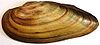
The "painter'southward mussel", a European freshwater mussel. Private shell halves were used by artists equally a modest dish for paint.
Application [edit]
Paint can be applied as a solid, a gaseous suspension (droplets) or a liquid. Techniques vary depending on the applied or artistic results desired.
Equally a solid (usually used in industrial and automotive applications), the paint is applied as a very fine powder, so baked at high temperature. This melts the powder and causes information technology to adhere to the surface. The reasons for doing this involve the chemistries of the paint, the surface itself, and peradventure even the chemistry of the substrate (the object beingness painted). This is called "powder coating" an object.
As a gas or as a gaseous suspension, the paint is suspended in solid or liquid form in a gas that is sprayed on an object. The paint sticks to the object. This is called "spray painting" an object. The reasons for doing this include:
- The application mechanism is air and thus no solid object touches the object beingness painted;
- The distribution of the paint is uniform, so there are no sharp lines;
- It is possible to deliver very small amounts of pigment;
- Painting multiple items at once quickly and efficiently;
- A chemic (typically a solvent) tin can be sprayed forth with the pigment to dissolve together both the delivered pigment and the chemicals on the surface of the object being painted;
- Some chemical reactions in paint involve the orientation of the pigment molecules.
In the liquid application, paint can be practical by direct application using brushes, paint rollers, blades, scrapers, other instruments, or body parts such as fingers and thumbs.
Rollers generally have a handle that allows for different lengths of poles to be attached, allowing painting at different heights. Generally, roller application requires ii coats for fifty-fifty color. A roller with a thicker nap is used to utilize pigment on uneven surfaces. Edges are often finished with an angled brush.
- Using the finish flat one would most likely use a 1/two" nap roller
- Using the finish eggshell ane would most probable use a 3/eight" nap roller
- Using the finish satin or pearl 1 would most probable use a 3/8" nap roller
- Using the cease semi-gloss or gloss i would most likely apply a 3/16" nap roller
[31]
After liquid paint is applied, in that location is an interval during which it can be blended with boosted painted regions (at the "wet edge") chosen "open time". The open fourth dimension of an oil or alkyd-based emulsion pigment can exist extended past calculation white spirit, similar glycols such as Dowanol (propylene glycol ether) or open up time prolongers. This can also facilitate the mixing of dissimilar wet paint layers for aesthetic result. Latex and acrylic emulsions require the use of drying retardants suitable for water-based coatings. Depending on the quality and type of liquid paint used, the open up fourth dimension will vary. Oil paints for instance are renowned for their open fourth dimension as oil paints allow for artists to blend the colors for extended periods of time without having to add any extending agents.
Paint application by spray is the well-nigh popular method in industry. In this, paint is aerosolized by the strength of compressed air or by the action of high pressure compression of the paint itself, and the pigment is turned into small-scale droplets that travel to the article to be painted. Alternate methods are airless spray, hot spray, hot airless spray, and any of these with an electrostatic spray included. In that location are numerous electrostatic methods available.
Dipping used to be the norm for objects such as filing cabinets, only this has been replaced by high speed air turbine driven bells with electrostatic spray. Car bodies are primed using cathodic elephoretic primer, which is practical by charging the body depositing a layer of primer. The unchanged balance is rinsed off and the primer stoved.
Many paints tend to separate when stored, the heavier components settling to the bottom, and require mixing earlier use. Some pigment outlets have machines for mixing the paint by shaking the can vigorously for a few minutes.
The opacity and the film thickness of paint may exist measured using a drawdown carte.
Water-based paints tend to be the easiest to clean up later on use; the brushes and rollers can exist cleaned with soap and water.
Proper disposal of left over paint is a challenge. Sometimes it tin be recycled: Old paint may be usable for a primer coat or an intermediate coat, and paints of similar chemistry can exist mixed to make a larger amount of a uniform color.
To dispose of paint it can be dried and tending of in the domestic waste stream, provided that it contains no prohibited substances (see container). Disposal of liquid paint usually requires special handling and should be treated as hazardous waste, and disposed of according to local regulations.[32] [33]
Product variants [edit]

A drove of cans of paint and variants
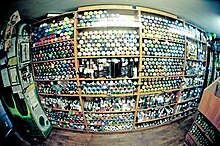
A huge collection of dissimilar kinds of spray cans, markers, paints, and inks in the hole-and-corner graffiti shop. Russian federation, Tver Metropolis, 2011.
- Primer is a preparatory coating put on materials earlier applying the paint itself. The primed surface ensures better adhesion of the paint, thereby increasing the durability of the paint and providing improved protection for the painted surface. Suitable primers as well may block and seal stains, or hide a color that is to be painted over.
- Emulsion paints are water-based paints in which the paint textile is dispersed in a liquid that consists mainly of water. For suitable purposes this has advantages in fast-drying, low toxicity, low cost, easier application, and easier cleaning of equipment, among other factors.
- Varnish and shellac are in effect paints without pigment; they provide a protective coating without essentially changing the color of the surface, though they can emphasise the colour of the material.
- Wood stain is a type of paint that is formulated to be very "sparse", meaning low in viscosity, so that the pigment soaks into a material such as wood rather than remaining in a flick on the surface. Stain is mainly dispersed pigment or dissolved dye plus binder material in a solvent. Information technology is designed to add together colour without providing a surface coating.
- Lacquer is a solvent-based paint or varnish that produces an especially difficult, durable finish. Normally it is a rapidly drying conception.
- Enamel paint is formulated to give an especially hard, ordinarily glossy, finish. Some enamel paints comprise fine drinking glass pulverisation or metal flake instead of the color pigments in standard oil-based paints. Enamel pigment sometimes is mixed with varnish or urethane to improve its polish and hardness.
- A glaze is an additive used with paint to slow drying time and increase translucency, every bit in faux painting and for some artistic effects.
- A roof coating is a fluid that sets as an elastic membrane that tin can stretch without harm. It provides UV protection to polyurethane foam and is widely used in roof restoration.
- Fingerpaints are formulations suitable for application with the fingers; they are popular for use by children in primary schoolhouse activities.
- Inks are similar to paints, except that they are typically made using finely ground pigments or dyes, and are non designed to leave a thick flick of binder. They are used largely for writing, printing, or calligraphy.
- Anti-graffiti coatings are used to defeat the marking of surfaces by graffiti artists or vandals. There are two categories of anti-graffiti coatings: sacrificial and non-bonding:
-
- Sacrificial coatings are clear coatings that allow the removal of graffiti, usually past washing the surface with high-force per unit area h2o that removes the graffiti together with the coating (hence the term "sacrificial"). After removal of the graffiti, the sacrificial blanket must exist re-applied for continued protection. Such sacrificial protective coatings are most commonly used on natural-looking masonry surfaces, such every bit statuary and marble walls, and on rougher surfaces that are difficult to make clean.
- Non-bonding coatings are articulate, high-operation coatings, usually catalyzed polyurethanes, that do non bond strongly to paints used for graffiti. Graffiti on such a surface tin be removed with a solvent wash, without dissentious either the underlying surface or the protective non-bonding coating. These coatings piece of work best on smooth surfaces, and are especially useful on decorative surfaces such as mosaics or painted murals, which might be expected to endure damage from high pressure sprays.
- Urine-repellent paint is a very hydrophobic (water-repellent) paint. Information technology has been used past cities and other property owners to deter men from urinating against walls, as the urine splashes back on their shoes, instead of dripping downwards the wall.[34] [35] [36]
- Anti-climb paint is a not-drying paint that appears normal but is extremely glace. It is useful on drainpipes and ledges to deter burglars and vandals from climbing them, and is found in many public places. When a person attempts to climb objects coated with the pigment, it rubs off onto the climber, as well as making it hard for them to climb.
- Anti-fouling paint, or bottom paint, prevents barnacles and other marine organisms from adhering to the hulls of ships.
- Insulative paint or insulating paint, reduces the charge per unit of thermal transfer through a surface it's applied to. Ane type of formulation is based on the addition of hollow microspheres to any suitable blazon of paint.
- Anti-slip paint contains chemicals or grit to increase the friction of a surface and then equally to decrease the risk of slipping, particularly in wet weather.
- Road marking paint [37] is specially used to mark and painting route traffic signs and lines, to form a durable blanket movie on the route surface. It must be fast-drying, provide a thick blanket, and resist wear and slipping, peculiarly in moisture conditions.
- Luminous pigment or luminescent pigment is paint that exhibits brilliance. In other words, information technology gives off visible light through fluorescence, phosphorescence, or radioluminescence.
- Chalk paint is a decorative pigment used for home decor to achieve looks such as shabby chichi or vintage with home decor.
Finish types [edit]
- Flat Finish paint is generally used on ceilings or walls that are in bad shape. This cease is useful for hiding imperfections in walls and information technology is economical in finer roofing relatively great areas. However, this finish is non easily washable and is subject to staining.
- Matte Finish is more often than not like to flat finish, but such paints commonly offering superior washability and coverage. (Run across Gloss and matte pigment.)
- Eggshell Stop has some sheen, supposedly like that of the trounce on an egg. This finish provides smashing washability, but is not very effective at hiding imperfections on walls and similar surfaces. Eggshell finish is valued for bathrooms because it is washable and water repellent, then that it tends non to peel in a wet environs.
- Pearl (Satin) Terminate is very durable in terms of washability and resistance to moisture, fifty-fifty in comparison to an eggshell terminate. It protects walls from dirt, moisture, and stains. Appropriately, information technology is exceptionally valuable for bathrooms, furniture, and kitchens, but it is shinier than eggshell, so information technology is fifty-fifty more prone to show imperfections.
- Semi-Gloss Stop typically is used on the trim to emphasize detail and elegance, and to show off woodwork, such equally on doors and furniture. It provides a shiny surface and provides practiced protection from moisture and stains on walls. Its gloss does however emphasize imperfections on the walls and like surfaces. It is pop in schools and factories where washability and immovability are the main considerations.[38]
- Loftier-gloss paint is a highly glossy and super shiny grade of paint that is light reflecting and has a mirror-like expect. It pairs well with other finishes. While information technology is highly durable and like shooting fish in a barrel to clean, high gloss paint is known for obvious visibility of imperfections like scratches, dents.[39]
Failure [edit]
The main reasons for paint failure afterward awarding on the surface are the applicator and improper treatment of the surface.
Defects or deposition can be attributed to:
- Dilution
- This unremarkably occurs when the dilution of the pigment is not done as per manufacturers recommendation. There tin be a instance of over dilution and under dilution, besides equally dilution with the wrong diluent.
- Contamination
- Foreign contaminants added without the manufacturers' consent tin can cause various movie defects.
- Peeling/Blistering
- Most commonly due to improper surface treatment earlier application and inherent wet/dampness being nowadays in the substrate. The caste of blistering can be assessed according to ISO 4628 Part 2 or ASTM Method D714 (Standard Test Method for Evaluating Degree of Blistering of Paints).
- Chalking
- Chalking is the progressive powdering of the pigment picture on the painted surface. The primary reason for the trouble is polymer degradation of the paint matrix due to exposure of UV radiation in sunshine and condensation from dew. The degree of chalking varies as epoxies react quickly while acrylics and polyurethanes tin can remain unchanged for long periods.[40] The degree of chalking tin can be assessed according to International Standard ISO 4628 Part 6 or 7 or American Gild of Testing and Materials(ASTM) Method D4214 (Standard Test Methods for Evaluating the Degree of Chalking of Exterior Paint Films).

2K Polyurethane paint progressively chalking
- Not bad
- Nifty of paint movie is due to the unequal expansion or wrinkle of paint coats. It usually happens when the coats of the paint are non immune to cure/dry completely before the side by side coat is practical. The caste of cracking can be assessed according to International Standard ISO 4628 Role 4 or ASTM Method D661 (Standard Test Method for Evaluating Caste of Neat of Exterior Paints). Cracking can also occur when the paint is applied to a surface that is incompatible or unstable. For instance, dirt that hasn't stale completely when painted volition crusade the paint to cleft due to the rest moisture in the clay.
- Erosion
- Erosion is very quick chalking. It occurs due to external agents like air, water etc. It can be evaluated using ASTM Method ASTM D662 (Standard Exam Method for Evaluating Degree of Erosion of Exterior Paints). The generation of acid past fungal species can be a significant component of erosion of painted surfaces.[41] The fungusAureobasidium pullulans is known for dissentious wall paints.[42]
Dangers [edit]
Volatile organic compounds (VOCs) in paint are considered harmful to the surroundings and specially for people who piece of work with them on a regular basis. Exposure to VOCs has been related to organic solvent syndrome, although this relation has been somewhat controversial.[43] The controversial solvent 2-butoxyethanol is likewise used in pigment product.[44] Jurisdictions such as Canada, Communist china, the EU, India, the United States, and South Korea have definitions for VOCs in identify, along with regulations to limit the employ of VOCs in consumer products such equally paint.[45] [46]
In the US, environmental regulations, consumer demand, and advances in technology led to the evolution of low-VOC and zippo-VOC paints and finishes. These new paints are widely available and run into or exceed the one-time high-VOC products in performance and cost-effectiveness while having significantly less impact on human and environmental health.[47]
A polychlorinated biphenyl (PCB) was reported (published in 2009) in air samples collected in Chicago, Philadelphia, the Arctic, and several sites effectually the Not bad Lakes. PCB is a global pollutant and was measured in the wastewater effluent from pigment production. The widespread distribution of PCB suggests volatilization of this compound from surfaces, roofs etc. PCB is present in consumer goods including newspapers, magazines, and cardboard boxes, which unremarkably comprise colour pigments. Therefore, a hypothesis exists that PCB congeners are present as byproduct in some current commercial pigments.[48]
See too [edit]
- Adhesive
- Aerosol paint
- Anti-graffiti coating
- Bresle method
- Brush
- Coating
- Figurer graphics
- Distressing
- Environmental problems with paint
- Simulated painting
- Painting
- Formulations
- Fresco
- Gloss and matte pigment
- Interior radiation control coating
- Lacquer
- Listing of art media
- NACE International
- Paint adhesion testing
- Paint recycling
- Paint (software)
- Paint stripper
- Powder coating
- Primer
- Route surface marking
- Roof blanket
- Soy paint
- Stain-blocking primer
References [edit]
- ^ "Painting 101: Oil or Latex?".
- ^ "What's the Ideal Outdoor Temperature Range for Using Exterior Pigment?".
- ^ Craughwell, Thomas J., 1956- (2012). 30,000 years of inventions. New York: Tess Press. ISBN9781603763240. OCLC 801100207.
{{cite volume}}: CS1 maint: multiple names: authors list (link) - ^ Hillary Mayell (March 31, 2004). "Is Bead Find Proof Modern Thought Began in Africa?". National Geographic News. p. 2. Retrieved May 20, 2016.
Work published in 2001 described 28 os tools and thousands of pieces of ocher—a mineral used to create pigment for torso decoration and cave painting—dated at roughly seventy,000 years old found in Blombos Cave in South Africa. Two pieces of ocher appear to be marked with abstract lines that could be viewed equally artistic expression.
- ^ a b "Stone Age painting kits institute in cave". The Guardian. October xiii, 2011. Retrieved May xx, 2016.
- ^ Stephanie Pappa (Oct 13, 2011). "Oldest Human Paint-Making Studio Discovered in Cave". Live Scientific discipline . Retrieved October 14, 2011.
- ^ "Painted walls in Orkney five,000 years onetime". BBC News. 26 July 2010. Retrieved ten March 2021.
- ^ "Painted walls". The Ness of Brodgar Excavation. 2011-08-05. Retrieved 2021-03-10 .
- ^ "Oldest Oil Paintings Found in Afghanistan" Archived June 3, 2011, at the Wayback Auto, Rosella Lorenzi, Discovery News. Feb. nineteen, 2008.
- ^ Theophilus Presbyter Book I ch. 25
- ^ Barbera, Giocchino (2005). Antonello da Messina, Sicily'south Renaissance Primary (exhibition catalogue). New York: Metropolitan Museum of Art Yale University Press. ISBN 0-300-11648-9 (online), p. 14
- ^ Ploeger, Rebecca (2013). "Characterization and Stability Issues of Artists' Alkyd Paints" (PDF). New Insights into the Cleaning of Paintings: Proceedings from the Cleaning 2010 International Conference, Universidad Politécnica de Valencia and Museum Conservation Institute. 3: 89–91.
- ^ a b Wicks, Zeno W., Jr.; Jones, Frank North.; Pappas, South. Peter; Wicks, Doublas A. (2004). Organic Coatings: Scientific discipline and Technology (third ed.). Hoboken, New Jersey, United states: John Wiley & Sons, Inc. p. five. ISBN978-0-471-69806-7.
- ^ Lambourne, R; Strivens, T A (1999). Pigment and Surface Coatings: Theory and Do (2nd ed.). Abington, Cambridge, England: Woodhead Publishing Express. p. 6. ISBN1-85573-348-X.
- ^ "Vermeer's Palette: The Anatomy of Pigment and Binder". www.essentialvermeer.com . Retrieved 2015-10-21 .
- ^ Baird, Colin; Cann, Michael (2012-06-30). CourseSmart International E-Book for Ecology Chemistry. Palgrave Macmillan. ISBN9781464162879.
- ^ Baghdachi, J. "Polymer Systems and Moving picture Germination Mechanisms in High Solids, Powder and UV Cure Systems" (PDF). Gild of Wood Science and Technology. Society of Wood Science and Technology. Retrieved 2016-01-13 .
- ^ "H2o-based Alchemy". Archived from the original on August 29, 2012. Retrieved Baronial 11, 2012.
- ^ Gite, V. V., et al. "Polyurethane coatings using trimer of isophorone diisocyanate." (2004).
- ^ Berendsen, A. M., & Berendsen, A. M. (1989). Marine painting manual. London: Graham & Trotman. ISBN one-85333-286-0 p. 114.
- ^ http://news.thomasnet.com/fullstory/acrylic-folder-improves-hardness-in-low-voc-architectural-paints-2005047 [ expressionless link ]
- ^ Gürses, Ahmet; Açıkyıldız, Metin; Güneş, Kübra; Gürses, M. Sadi (2016-05-04). Dyes and Pigments. Springer. ISBN9783319338927.
- ^ "Archives". Los Angeles Times.
- ^ "MIO Coatings – What Are They?" (PDF). Dulux Protective Coatings. 2009.
- ^ "ISO 10601:2007". Micaceous iron oxide pigments. International Organization for Standardization.
- ^ frpdesigns.com Archived 2010-02-11 at the Wayback Machine, "Formulations, Fundamentals, Manipulation, Calculation and Data Management" p. 61.
- ^ Bramley, Christopher Sinjin. "Color changing paint" (PDF). European Patent Application EP1400574. European Patent Part.
- ^ "Dramatic color modify featured". New Materials International. Archived from the original on 2012-04-25. Retrieved 2011-xi-03 .
- ^ Horvath, Lee. "Coatings Get Across Appearance to Provide Quality Control". Foundry Applied science. Foundry Management & Applied science.
- ^ "DailyTech - Nissan Develops Color Changing Paint for Vehicles". Archived from the original on 2011-07-08. Retrieved 2008-03-19 .
- ^ "Selecting the Right Paint Roller." Selecting the Correct Paint Roller. Aubuchon Hardware, 2006. Web. 05 May 2012. <"Archived re-create". Archived from the original on 2012-04-20. Retrieved 2012-05-06 .
{{cite web}}: CS1 maint: archived copy as title (link)>. - ^ ""Safe Use, Storage and Disposal of Pigment"". Archived from the original on 2007-02-24. Retrieved 2006-11-01 .
- ^ "Storage and Disposal of Pigment Facts" Archived 2007-11-18 at the Wayback Machine
- ^ Huggler, Justin (2015-03-04). "Hamburg fights back against urination on streets with walls that 'pee back'". The Telegraph. ISSN 0307-1235. Retrieved 2020-04-02 .
- ^ Johnson, Lizzie (2015-07-31). "Due south.F.'south new urine-resistant walls seem to exist keeping things dry". SFGate . Retrieved 2020-04-02 .
- ^ "'Anti-pee' walls will splash offenders". BBC News. 2015-12-17. Retrieved 2020-04-02 .
- ^ "route marking paint". Archived from the original on 2015-02-15. Retrieved 2014-09-15 .
- ^ "Paint Finish and Sheen Information; Info on Satin, Eggshell, Matte, and Other Pigment Finishes." Professional Painting Contractor. Professional Painters, 2011. Web. 07 Apr. 2012. <http://www.painter-pros.com/finishes.php Archived 2012-09-06 at archive.today>.
- ^ Mendelsohn, Hadley (2019-03-13). "Designers Are Going Nuts Over This Super Glossy Paint". Firm Cute . Retrieved 2019-04-11 .
- ^ Bayliss, D.A.; Deacon, D.H. (2002). Steelwork corrosion control (2nd ed.). London: Spon. pp. 13.6.6 Chalking. ISBN978-0-415-26101-two.
- ^ Xiaohui Wang; Ling Wang (2006). "Measures and Examination Techniques for Fungus Resistance to Aircraft Materials and Equipment" (PDF).
- ^ John W. Taylor; Joey Spatafora; Mary Berbee (1996). "Ascomycota".
- ^ SPURGEON A (2006). "Watching Paint Dry: Organic Solvent Syndrome in tardily-Twentieth-Century Britain". Medical History. 50 (ii): 167–188. doi:10.1017/s002572730000973x. PMC1472097. PMID 16711296.
- ^ "Ethylene Glycol Mono-N-Butyl Ether". National Library of Medicine HSDB. Retrieved 2014-03-14 .
- ^ "South korea expands VOC controls and tightens limits in paint". chemicalwatch.com . Retrieved 2021-03-27 .
- ^ "Volatile Organic Compounds (VOC) and Consumer Products Regulations". www.chemsafetypro.com . Retrieved 2021-03-27 .
- ^ Chang, John C. S.; Fortmann, Roy; Roache, Nancy; Lao, Huei-Chen (1999). "Evaluation of Low-VOC Latex Paints". Indoor Air. nine (iv): 253–258. doi:10.1111/j.1600-0668.1999.00004.x. ISSN 0905-6947. PMID 10649858.
- ^ Hu, D; Hornbuckle, KC (2010). "Inadvertent polychlorinated biphenyls in commercial paint pigments". Environ Sci Technol. 44 (8): 2822–seven. Bibcode:2010EnST...44.2822H. doi:10.1021/es902413k. PMC2853905. PMID 19957996.
Further reading [edit]
- Bently, J. (Author) and Turner, Thou.P.A. (Author) (1997). Introduction to Pigment Chemistry and Principles of Pigment Applied science. Unk. ISBN0-412-72320-iv.
- Talbert, Rodger (2007). Paint Technology Handbook. M Rapids, Michigan, Usa. ISBN978-ane-57444-703-3.
- Woodbridge, Paul R., ed. (1991). Principles of Pigment Conception. Unk. ISBN0-412-02951-0.
 | Look up paint in Wiktionary, the free dictionary. |
 | Wikimedia Eatables has media related to paint. |

Source: https://en.wikipedia.org/wiki/Paint
Posted by: twiggsdayssiders67.blogspot.com
0 Response to "What Kind Of Paint Is Easy To Clean"
Post a Comment